
Why Junior Developers Are the Real Victims of AI Hype
The conversation around AI and software development often focuses on one dramatic question:
Will AI replace developers?
In reality, that’s not where the biggest impact is happening.
The most immediate disruption is appearing somewhere else — at the very beginning of the career ladder.
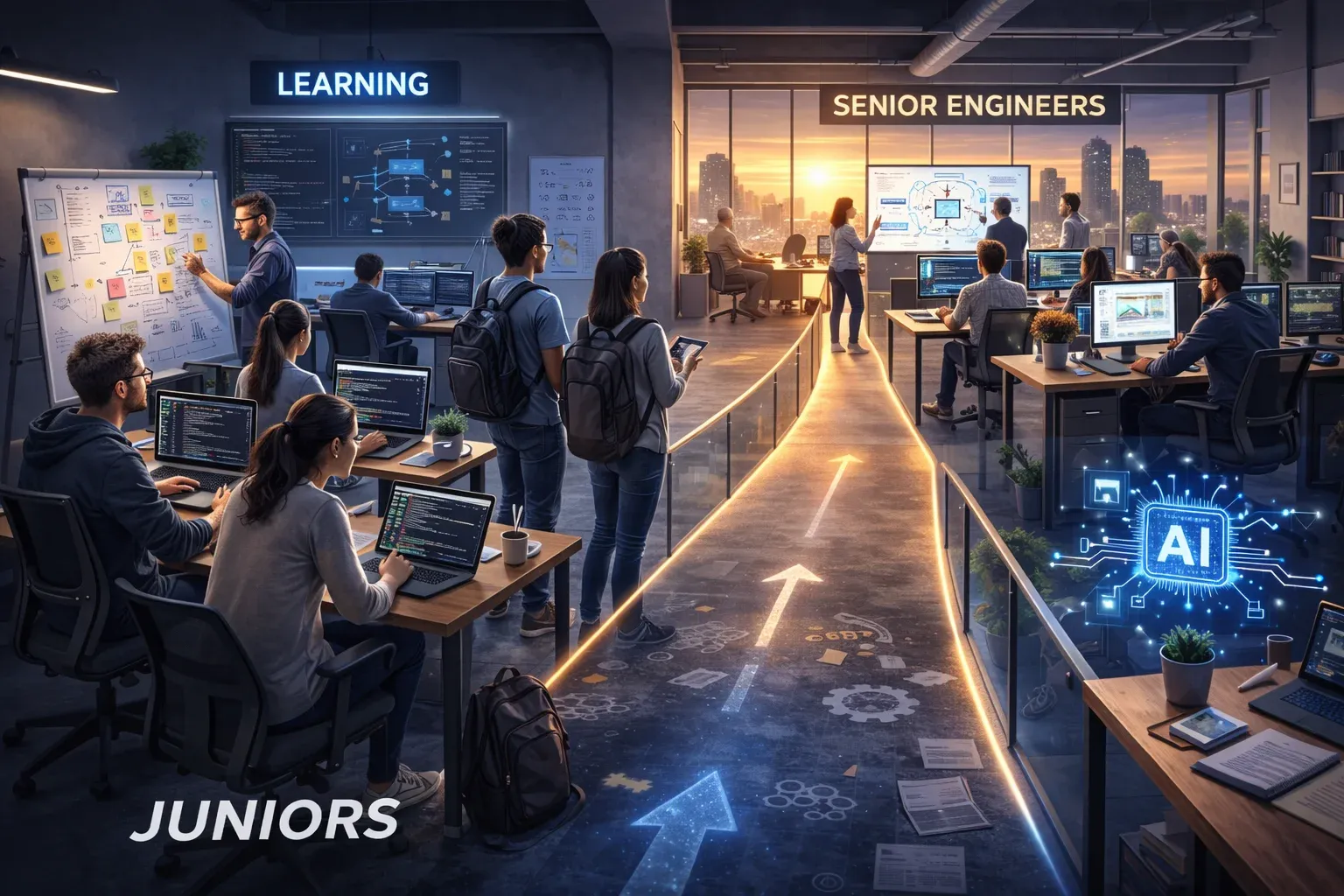
Junior developers are quietly becoming the most exposed group in the current AI hype cycle.
Not because they are less capable.
But because the structure of the industry is shifting around them.
TL;DR
- AI compresses a lot of entry‑level engineering tasks
- Companies are becoming more cautious about junior hiring
- Learning pathways into the profession are getting less clear
- The gap between learning and real production work is widening
- This makes mentorship and real-world experience more important than ever
---
The Traditional Entry Path
For years, the path into software engineering followed a familiar pattern.
A junior developer would join a team and spend their first months working on smaller, well‑defined tasks:
- simple bug fixes
- documentation improvements
- small features
- test coverage
- basic refactoring
These tasks were not trivial.
They were training grounds.
They allowed juniors to:
- learn the codebase
- observe production systems
- receive feedback from senior engineers
- build intuition about how software behaves in the real world
In other words, junior work was part of the learning infrastructure of the profession.
---
What AI Changes
AI is extremely good at many of the tasks that traditionally filled that junior learning space.
Generating boilerplate.
Writing simple endpoints.
Creating test cases.
Suggesting refactors.
Explaining APIs.
These are exactly the kinds of tasks that helped new developers gain experience.
So when companies look at productivity tools, an uncomfortable question appears:
Do we still need as many junior developers for these tasks?
For some teams, the answer becomes less obvious.
---
The Hidden Risk: Fewer On-Ramps
This does not mean AI replaces junior engineers.
But it does mean something else.
The entry ramp into the profession may become narrower.
If fewer entry-level tasks exist, fewer entry-level roles may be created.
And if fewer juniors enter the system today, the industry risks creating a future shortage of experienced engineers.
Experience does not appear magically.
It accumulates through exposure to real systems over time.
---
The Experience Gap
There is another challenge hidden inside this shift.
AI can help juniors produce code faster.
But faster output does not automatically produce deeper understanding.
Without careful guidance, it is possible for new developers to:
- ship code they do not fully understand
- rely on patterns they cannot evaluate
- skip the slow process of learning system behavior
In other words, AI can accelerate output while slowing the development of judgment.
That is a dangerous combination if teams are not intentional about mentorship.
---
Why Mentorship Becomes More Important
If AI compresses mechanical work, the value of mentorship increases.
Junior developers will need more help learning:
- how systems fail
- how to read production signals
- how to reason about trade-offs
- how to navigate ambiguity
These skills were never learned from syntax alone.
They were learned by working alongside engineers who had already seen things break.
AI cannot replace that transfer of experience.
---
What This Means for Juniors
For developers at the beginning of their careers, the strategy may need to change slightly.
Instead of focusing only on writing code, it becomes important to actively seek exposure to:
- system architecture
- production incidents
- observability tools
- design discussions
- post‑mortems
The earlier you understand how real systems behave, the faster you build the judgment that automation cannot easily replace.
---
What This Means for the Industry
There is also a responsibility on the industry itself.
If companies stop investing in junior developers entirely, they risk creating a long-term talent shortage.
Strong engineering cultures have always invested in mentorship and apprenticeship.
That principle becomes even more important when tools accelerate the easy parts of the job.
The profession still needs new engineers.
It just needs to think more carefully about how they are trained.
---
A More Honest Conversation
The AI discussion often swings between two extremes:
- AI will replace developers
- AI will change nothing
Neither is accurate.
AI is changing the shape of the learning curve for new engineers.
Understanding that shift early allows teams and developers to adapt before the consequences become structural.
---
Closing Thought
Every experienced engineer was once a junior developer learning how real systems behave.
That apprenticeship model built the profession we have today.
If AI compresses the early stages of engineering work, the industry will need to become more intentional about preserving that learning path.
Because the senior engineers of tomorrow still have to come from somewhere.
---
Want to Discuss This?
I don’t run comments on this blog.
If you have thoughts about how AI is changing the junior developer journey — or if you’re experiencing this transition yourself — feel free to reach out to me on LinkedIn. I genuinely enjoy thoughtful discussions.